
Introduction
For years, enterprise automation followed a straightforward path: find a repetitive task, define the rules, and let software execute it faster and more consistently. Robotic Process Automation (RPA) proved the value of that model across data entry, transaction processing, reporting and system updates.
But business processes rarely remain isolated. A single outcome may depend on documents, multiple applications, APIs, business rules, approvals, exceptions, and human judgment. Automating one step can improve that step while leaving the overall process fragmented.
Intelligent Process Automation (IPA) emerged to close that gap. It combines RPA with AI, intelligent document processing, analytics, decision logic, and orchestration so that more of the process can be understood, coordinated, and automated from input to outcome.
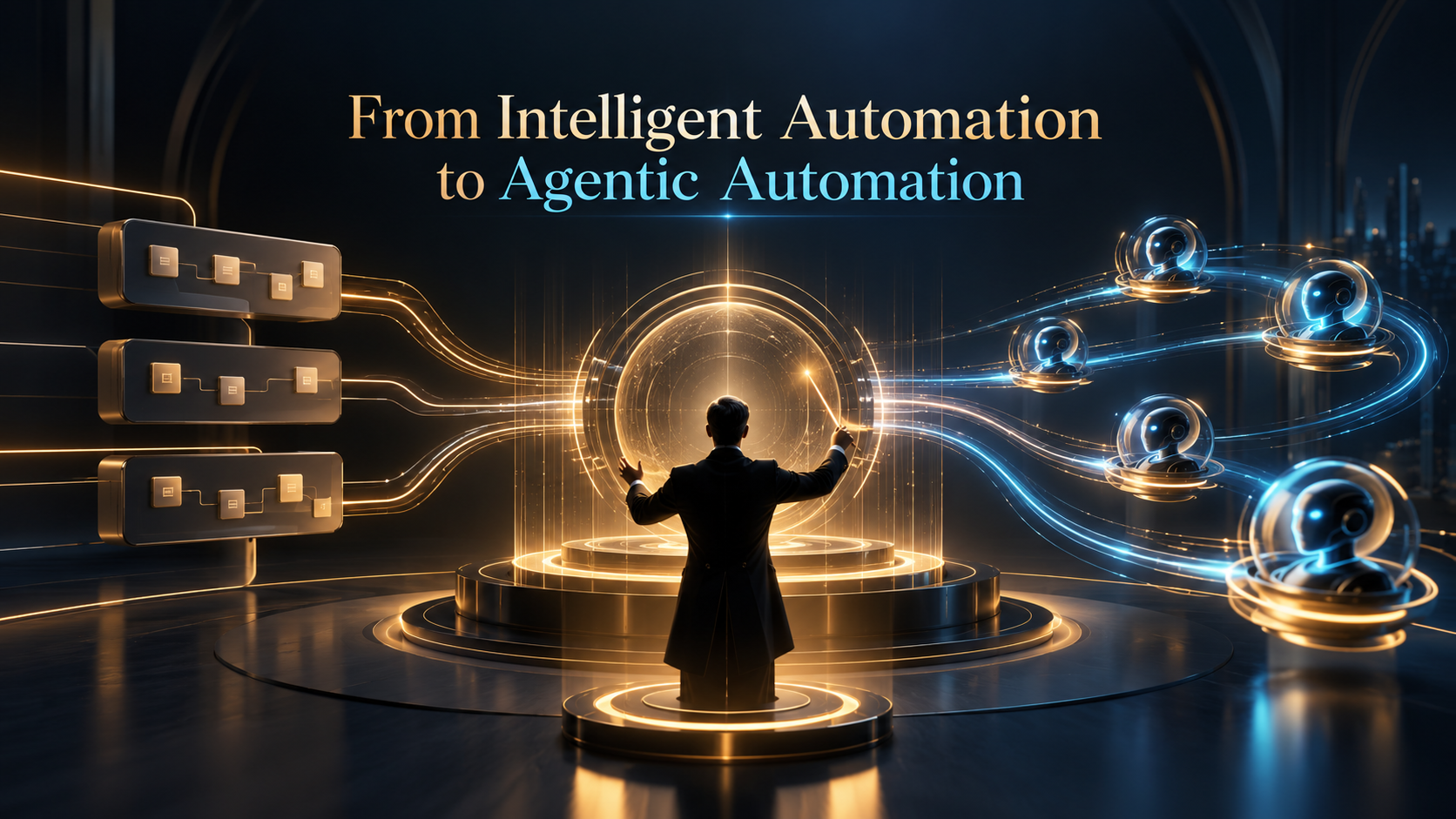
Now automation is entering another stage. Agentic automation introduces AI agents that can interpret context, work toward a defined goal, decide what action is needed next, use approved tools, and escalate when human judgment is required. The shift is not from “bots” to “agents” as competing technologies. It is from automating predefined activities to coordinating increasingly adaptive work across the enterprise.
The evolution is best understood as a progression: RPA executes predefined tasks. IPA combines intelligence and automation to coordinate business processes. Agentic automation adds goal-directed, adaptive decision-making where the next action cannot always be fully specified in advance. These approaches can work together within a governed workflow.
RPA Automated the Task. IPA Connected the Process.
Traditional RPA is highly effective when work is structured, repetitive, and governed by clear rules. If a user performs the same steps in the same applications with predictable inputs, a bot can often execute those steps reliably.
IPA extends that model when the process requires more than execution. AI can interpret information. Intelligent document processing can extract data from invoices, forms or claims. Decision logic can apply business rules. Orchestration can move work across systems and people. Analytics can monitor what happened and where friction remains.
The important change is the unit of automation. Instead of asking only, “Which task can we automate?" IPA encourages organizations to ask, “Which business process creates friction, and where can intelligence and automation improve the outcome?”
Example: From invoice entry to an intelligent accounts-payable flow
An RPA bot might take invoice data and enter it into an ERP system. An intelligent automation flow can go further: capture the invoice, extract key fields, validate them against purchase orders, apply approval rules, identify exceptions, route those exceptions to the right person, continue processing after approval, and record the outcome.
The business value does not come from having more automation components. It comes from removing waiting, rekeying, avoidable errors and unnecessary handoffs across the complete flow.
IPA Expanded Automation, but Many Workflows Still Depend on Predefined Paths
IPA can handle more variation than traditional RPA, but many implementations still depend on workflows that are designed in advance: if this condition occurs, follow this path; if an exception appears, route it to this queue; if approval is received, continue to the next step.
That model remains valuable, especially in stable and regulated processes. Its limitation appears when the next action cannot be fully anticipated at design time—when the automation must interpret changing context, gather additional information, choose between several possible actions, or coordinate a sequence of steps toward an outcome.
This is where agentic automation adds a new capability. Rather than only following a fixed path, an AI agent can operate within defined boundaries and determine how to progress toward an assigned goal. It can reason over available context, select approved tools or actions, check the result, and adjust the next step while remaining subject to business rules, permissions and human oversight.
Agentic automation therefore does not make RPA or IPA obsolete. RPA still executes predictable work extremely well. APIs remain the most direct way to connect many systems. Business rules are still essential where decisions must be deterministic. Human judgment remains necessary for sensitive, ambiguous or high-impact cases. Agents add adaptability where the process benefits from it.
Agentic Automation Adds a Decision-and-Action Loop to Intelligent Automation
A useful way to think about agentic automation is as a governed loop rather than a single model response. The agent receives a goal and context, determines what it needs to do, takes an approved action, observes the result, and decides what should happen next.
Understand the context: Interpret the request, case, document, process state, or business event using the information available to it.
Decide the next step: Determine which action is appropriate within defined objectives, business rules, policies and permissions.
Act through enterprise tools: Once the agent has selected an appropriate next step, it can use an approved tool to carry it out—for example, call an API, trigger an RPA bot, query a system, update a record, request information, create a task or route work to a person. These actions can also be performed by conventional IPA workflows; the agentic element is how the next action is selected based on context.
Check the result: Evaluate whether the action moved the process toward the intended outcome or whether additional work is needed.
Escalate when required: Hand the case to a person when confidence is low, policy requires approval, or the decision carries material risk.
This makes agentic automation particularly relevant to processes where the route to completion may change from case to case. The enterprise challenge, however, is not simply giving an agent access to more tools. Those tools and decisions need to be coordinated safely. That is why orchestration becomes central.
Orchestration Becomes the Control Layer Behind Agentic Automation
In automation, orchestration means coordinating all the participants in a process so that the right work happens in the right order, with the right context and controls. Those participants may include enterprise applications, APIs, RPA bots, AI models or agents, people, business rules and governance mechanisms.
A simple task automation usually has a narrow boundary: perform this action in this application. Orchestration operates at a different level. It manages how work moves across the process. It knows, for example, when an API should be called, when a predefined workflow should trigger an RPA bot is needed because no API exists, when an agent can decide the next step, when a rule must be enforced, and when a person must review or approve the case.
This is increasingly important because modern automation is heterogeneous. Few enterprises run on one platform or one type of automation. A process may cross legacy applications, cloud services, email, documents, data platforms and human teams. Without orchestration, organizations can end up with many capable automations that still behave like disconnected islands.
Orchestration is not another bot. It is the coordination layer that connects systems, APIs, RPA, AI agents, people and rules into one governed flow toward a business outcome.
In agentic automation, orchestration also provides boundaries. It can control which tools an agent may use, what data it may access, which rules it must respect, when approval is mandatory, how actions are logged, and what happens when the automation cannot proceed confidently. In that sense, orchestration is as much about control and accountability as it is about connectivity.
The Best Agentic Use Cases Are Processes Where the Next Step Depends on Context
Not every process needs an AI agent. Highly stable, rules-based work may be better served by RPA, APIs or conventional workflow automation. Agentic automation becomes more useful when a process contains variable inputs, multiple possible actions, frequent context switching, or work that currently requires a person to gather information before deciding what to do next.
Example: How IPA and Agentic Automation Handle a Service Request
Consider an enterprise service request arriving through email or a portal. A conventional IPA workflow may classify the request, retrieve the required information and route it according to predefined conditions. If the case follows an expected path, the workflow can continue through configured rules, APIs or RPA bots. In an agentic workflow, an AI agent can interpret the request and, when the next step is not fully predetermined, identify what additional context is needed, select an approved way to obtain it, evaluate the result and determine the next appropriate action. It can still use the same APIs or RPA bots and must route the case to a person when the request falls outside its authority.
The impact is not simply fewer manual clicks. Where a case requires variable information gathering or a next step that cannot be fully predefined, agentic automation may reduce unnecessary handoffs and support faster resolution and better use of specialist time—while preserving human accountability for exceptions and sensitive decisions.
Don’t Measure Automation by the Number of Bots
A bot going live is a deployment milestone, not a business outcome. The same is true of an AI agent. Counting bots, automated processes, or agent deployments may indicate activity, but it says very little about whether the underlying operation has improved.
A small automation that removes a critical bottleneck can create more value than dozens of low-impact bots. Conversely, an organization can grow its automation estate while cycle times; exception queues, and customer frustration remain largely unchanged.
The stronger approach is to establish a baseline before automation and measure the performance of the process after the change. Depending on the use case, the most useful measures may include:
- Time saved: reduction in manual effort, waiting time, cycle time, or end-to-end completion time.
- Cost reduction: lower processing cost, avoidable operating expense, or cost per transaction.
- Faster processing: higher throughput, quicker response, or shorter service turnaround.
- Error and rework reduction: fewer data-entry errors, exceptions, corrections, or repeated work.
- Customer or employee experience: faster resolution, fewer handoffs, simpler interactions, and less repetitive work.
- Increased business capacity: ability to handle greater transaction or case volume without increasing manual effort at the same rate.
- Revenue or margin impact: improved conversion, faster revenue realization, reduced leakage, or better margins where the process directly influences financial performance.
- Risk and compliance: fewer policy deviations, stronger auditability, more consistent validation, and clearer accountability.
The metric should follow the business problem. If the original issue was a five-day turnaround time, the primary measure should be whether that turnaround improved—not how many automation components were deployed to achieve it.
Measure the improvement in the process, not the size of the automation estate.
Enterprises Should Decide Which Steps Need Fixed Rules and Which Need Adaptability
Moving toward agentic automation does not mean rebuilding every process around AI agents. A stronger approach is to design the operating model around the nature of the work and the level of control required.
Before introducing agentic capabilities, technology and process leaders should be able to answer a few practical questions:
- What business outcome are we trying to improve, and what is the current baseline?
- Which steps are predictable enough for APIs, RPA or rules, and which genuinely require interpretation or adaptive decision-making?
- What systems, data, and tools may the agent access, and what permissions should remain restricted?
- Which decisions must always remain deterministic or require human approval?
- How will actions, decisions, exceptions, and handoffs be monitored and audited?
- What happens when confidence is low, data is incomplete, a system is unavailable, or the agent cannot complete the task?
- How will we measure value after deployment and decide whether the automation should be expanded, redesigned, or stopped?
This keeps automation architecture grounded in the process rather than the novelty of technology. It also prevents a common mistake: applying an agent to work that would be simpler, cheaper, and more controllable with conventional automation.
The Next Automation Roadmap Starts with the Process, Not the Technology
The practical sequence for enterprises remains surprisingly consistent even as technology evolves.
Identify friction
Find processes where delays, manual effort, repeated handoffs, errors, fragmented systems, or limited capacity create a measurable problem.
Map how work actually moves
Understand the inputs, systems, decisions, people, exceptions and controls involved from start to outcome.
Define the business result
Choose the improvement that matters: speed, cost, quality, capacity, experience, compliance, revenue or margin.
Choose the right mix of automation
Use APIs, RPA, IDP, rules, AI and agents according to the nature of each step—not as a one-platform answer.
Design orchestration and governance
Define how components interact, where agents have authority, where humans intervene, and how actions are monitored.
Pilot against a baseline
Test a bounded process and compare the result with pre-automation performance.
Scale what proves value
Expand only when the automation is reliable, governed and producing measurable process improvement.
From “What Can We Automate?” to “How Should Work Be Coordinated?”
Enterprise automation has evolved from executing repetitive tasks to connecting processes and, increasingly, enabling software agents to work toward defined outcomes. RPA remains valuable. IPA remains the foundation for connecting intelligence, rules, systems, and people. Agentic automation adds adaptability where the next step cannot always be hard-coded in advance.
The critical capability of tying this together is orchestration: the control layer that coordinates APIs, bots, AI agents, people, business rules, and governance across the process.
The critical measure is equally clear. Success is not the number of bots deployed; agents launched, or workflows automated. It is whether the business process became faster, less costly, more accurate, easier to operate, more scalable, more compliant, or more valuable to the customer.
For technology leaders, the question is therefore evolving. It is no longer only, “What can we automate?” It is also, “Which outcomes matter, what combination of automation should deliver them, and how do we coordinate that work safely from start to finish?”