SwaaS IT Solutions

Jul 14, 2026

🔎 Founder Snapshot: Is Your SDLC Quietly Bleeding Time?

If any of these sound familiar, your delivery framework has a structural gap — not a people problem.

  • Sprints feel "busy" but not productive
  • 🔄 Same bugs reappear every 2–3 cycles
  • Deadlines slip despite strong teams
  • 🔀 QA finds what Dev assumed was specified

The FTR framework addresses each of these at the structural root — not with more process, but with smarter alignment.

Talk to Us About Your SDLC ↗

Where We Left Off

Why It Matters — And What Comes Next

In our previous blog (AI-Powered First-Time-Right (FTR) SDLC Framework - Fixing Structure Before Code), we asked one question: why do projects fail without FTR? And we traced the answer to its root; not in the code, not in the tools, but in the structural misalignment that happens before a single line of code is written.

We introduced the first two foundational pillars of our AI-Powered First-Time-Right SDLC Framework:

  • Pillar 1: The POD Model — replacing silos with shared ownership, where one cross-functional team owns the problem and the outcome end-to-end.
  • Pillar 2: Requirements & Design — replacing documentation-as-alignment with AI-validated intent capture, so everyone builds from the same truth.

These two pillars lay a deep foundation. They answer the questions that, when left unanswered, cause 40% of sprint time to disappear into clarification and rework.

But a foundation is only the beginning. The question that follows is: What happens when execution actually starts? When the sprint begins, when code is written, when testing runs, and when the team retrospects; does quality hold? Does it compound? Does the system get smarter?

That is what the remaining three pillars of the FTR framework are designed to ensure. And that is what this blog covers.

A strong foundation makes quality possible. The execution pillars make quality inevitable — sprint after sprint, team after team.

FTR Framework — Five Pillars at a Glance
Foundation Layer
POD Model
Requirements & Design
Execution Layer
Sprint Planning & Development
Testing
Review & Continuous Improvement

Pillar 3

Sprint Planning & Development — The Precision Engine

Fast Is Not the Same as Stable

For founders, sprint wobble isn't just a product engineering inconvenience; it's a runway disappearing in slow motion. Every day of misalignment is a day your competitor is iterating on real user feedback while your team is resolving confusion around requirements that should never have existed. The FTR precision engine doesn't just stabilize sprints; it converts product engineering time into market progress.

Most teams don't lack speed. They lack alignment.

Most teams experience what we call sprint wobble; the subtle but persistent instability that comes from starting a sprint before everyone is truly on the same page. The story looks clear in the backlog. The sprint starts strong. Then a developer hits an edge case no one discussed. QA realizes they are testing for a behavior that was assumed, not specified. A security concern surfaces that was deferred to "later."

The sprint doesn't crash. It just bleeds speed, day after day, until the release date is in jeopardy, and the team is exhausted from solving problems that should never have existed.

This is not an Agile problem. Agile is designed precisely to surface misalignment early. The issue is that most teams apply Agile practices without the structural foundations that make those practices effective. When planning isn't precise, development inherits ambiguity. And ambiguity always converts to rework; quietly, daily, and expensively.

"We'll fix it later" is the most expensive sentence in engineering. The FTR framework removes the conditions that make it necessary.

How FTR Solves Sprint Planning

In an FTR POD, sprint planning is a launch sequence and not a meeting. Every story is validated before the sprint begins. Every risk is surfaced. Every commitment is grounded in verified technical feasibility and actual capacity.

AI scans every story against the validated requirements from Pillar 2, flagging logic gaps, missing acceptance criteria, and conflicting assumptions before the sprint is locked. Dependencies are surfaced proactively. Edge cases are identified at the planning stage where they cost almost nothing to address; rather than mid-sprint, where they cost everything.

The result is one Sprint Truth, shared identically across PM, Dev, QA, and DevOps. Not four different understandings of the same plan. And the sprint doesn't begin until that ONE truth is established.

How FTR Solves Development

With a precise sprint foundation in place, development becomes a precision engine; a process that produces quality as a structural byproduct, not as a final inspection.

Coding standards are enforced automatically through AI-powered analysis. Not as a periodic code review gate, but as a continuous background process that flags deviations the moment they are introduced. Security and architecture checks run with every single commit; integrated into the development workflow rather than batched at the end of the sprint.

Crucially, QA validation starts while code is being written, not after it is done. Developers receive feedback in real time - before context is lost, before the behavior has been embedded in three downstream modules, before the correction cost has compounded.

The result: developers stop second-guessing. They build with certainty, knowing the standard is defined, compliance is continuous, and the feedback loop is fast enough to matter.

Stage 5C Pillars FTR Outcome
Sprint Planning Clarity + Correctness One Sprint Truth. Stable goals, accurate estimates, zero hidden scope.
Development Consistency + Compliance Uniform code quality. Built-in security. No late-stage architectural surprises.

0

Mid-sprint clarification interruptions disappear when alignment is real before the sprint begins.

Predictable release cycles, sprint after sprint; because wobble has been structurally removed.

Quality becomes a byproduct of the process, not a cost at the end of it.

Pillar 4

Testing — The Mirror, Not the Barrier

Why Late Testing Is the Most Expensive Mistake in Delivery

Testing is where reality finally shows up. And when it shows up late, the cost is not linear - it compounds. For founders, this is the difference between a Go-Live that builds confidence and one that quietly erodes it. Calm and stable releases aren't a luxury; they are what board trust is built on. When quality is continuous rather than last-minute, you stop managing fire drills and start managing growth.

A logic gap found 48 hours before release doesn't cost 48 hours to fix. It costs those hours plus the cognitive overhead of pulling a developer back to code written weeks ago. Plus the cascading effect of other modules that may have been built around that flawed behavior. Plus the schedule cost of a slipped release. Plus the confidence cost of a team that has just learned, again, that quality is still a gamble.

The structural problem is this: when testing is a final gate, teams are not just finding bugs; they are fighting the physics of lost momentum. The later feedback arrives, the more embedded the problem, and the more expensive the correction.

Most teams understand this intellectually. But without the structural changes introduced in Pillars 1 and 2, without aligned teams and validated requirements, there is nothing earlier in the cycle to catch what testing will eventually find. So, testing inherits everything.

The FTR framework changes that inheritance.

How FTR Reframes Testing

In an FTR POD, testing is not a phase - it is a continuous intelligence layer that runs from the first commit to the final release. Not as overhead but as a built-in mechanism for keeping reality aligned with intent.

AI continuously cross-references system behavior against the original captured intent from the requirement stage — the precise, AI-validated specification that was agreed on before the sprint began. This creates objective correctness: the question is not whether the developer thinks the feature is right, but whether it actually matches what was specified.

Defect patterns are analyzed not just to find individual bugs but to uncover the root causes behind recurring failure modes. AI identifies the "why" behind the "what" — the structural conditions that produce a class of defects; so that the same issue doesn't resurface in the next sprint. Every bug becomes a lesson. Every lesson becomes a systemic improvement.

Testing stops being the thing that slows releases down. It becomes the intelligence layer that makes fast releases safe.

Bugs are signals. Edge cases are insights. Testing doesn't slow you down — it removes the blind spots that cause you to trip.

Stage 5C Pillars FTR Outcome
Testing Correctness + Continuous Learning Intent and reality are perfectly aligned. Every defect becomes a lesson that prevents its recurrence.

🏁 Calmer releases

No midnight fire drills; quality built in from Day 0, not rushed in before go-live.

⚡ Stabilized velocity

Teams accelerate because they are not caught off-guard by late-cycle discoveries.

🧠 Compounding intelligence

The system measurably reduces its own defect rate with every sprint.

Pillar 5

Review & Continuous Improvement — Turning Delivery into Advantage

Finishing Is Not the Same as Learning

In our previous blog, we showcased the "Learning Leak" as the most persistent and least visible failure mode in software product delivery. There is this pattern where teams work hard, ship consistently, and somehow never break the cycles holding them back. Our proposed Pillar 5 is where that leak gets permanently closed.

Completing a sprint is not an accomplishment in itself. The accomplishment is whether the team is structurally better, faster, and smarter because of what the sprint revealed. For founders watching the same delivery patterns repeating across vendors and teams, Pillar 5 is the answer to the question nobody asks directly: why does this keep happening?

Structural learning means the system that delivers your product gets measurably and swiftly smarter with every sprint; compounding delivery capability the same way a good capital compounds max ROI returns.

Most retrospectives are, in practice, opinion meetings. The same themes surface. The same action items are noted. A few things change at the margin. And three sprints later, the same structural issues reappear because the insight lived in conversation, not in the system.

This is the Learning Leak — the last and most persistent failure mode in software delivery. Teams work hard, ship consistently, and somehow never fully break the patterns holding them back. Not because they aren't trying, but because the framework doesn't carry learning forward. It dissipates the moment the meeting ends.

The FTR framework closes this leak permanently.

How FTR Transforms Review and Retrospectives

In an AI-powered FTR POD, retrospectives are evidence-driven, not opinion-driven. Sprint data — velocity trends, defect rates, clarification frequency, test coverage, and deployment outcomes are automatically translated into performance signals. Patterns are surfaced across multiple sprints, not just the most recent one, removing the recency bias that distorts most team retrospectives.

The conversation shifts from "what happened" to "why it happened and what it reveals about the system." Teams stop debating perceptions and start analyzing data. The insights that emerge are sharper, more specific, and directly actionable — not vague commitments to "communicate better."

How FTR Makes Improvement Structural

This is the defining feature of Pillar 5: learning becomes structural. Proven improvements don't just become team norms; they become defaults encoded into the process itself.

Recurring issues trigger automation. A defect pattern that appears in consecutive sprints becomes a systematic fix, not another action item. Lessons are carried forward into the next sprint by design, not by memory. The POD doesn't just complete projects — it upgrades itself as it goes.

Teams stop tuning individual sprints and start improving the system. The shift in question is profound: "Did we finish?" to "How did we evolve?"

Every sprint is an upgrade cycle. Review in FTR is not a debrief — it is the mechanism by which delivery becomes a compounding competitive advantage.

Stage 5C Pillars FTR Outcome
Review & Retrospective Continuous Learning + Clarity Evidence-based retros. Insights become structural defaults, not verbal commitments.
Continuous Improvement Consistency + Continuous Learning Pattern recognition ensures mistakes are never repeated. The system learns permanently.

🔕 Reduced Operational Noise

Fewer recurring issues mean a calmer work environment.

📈 Predictable Velocity

Less variance and fewer "late-sprint surprises."

⚠️ Problem

Sprint starts with hidden uncertainty. Edge cases and requirement gaps are discovered mid-sprint, causing developers to stall and QA to test unspecified behaviors.

🎯 FTR Solution

AI validates every story against Pillar 2 requirements, flagging logic gaps, missing acceptance criteria, and conflicting assumptions — before the sprint is locked.


✅ Outcome

One Sprint Truth, shared identically across PM, Dev, QA, and DevOps. Zero mid-sprint confusion. Development becomes a precision engine, not a discovery exercise.

Measurable Impact

What the Numbers Look Like

Finishing Is Not the Same as Learning

When all five pillars work together — when the right team structure, validated requirements, precise planning, continuous testing, and structural learning operate as an integrated system — the results stop being surprising. They become predictable.

↓ Rework

40%

Less rework: Engineering effort shifts permanently from fixing to building.

↓ Clarifications

40%

Less rework: Engineering effort shifts permanently from fixing to building.

↓ Mismatches

Less variance and fewer "late-sprint surprises."

↑ Speed

40%

Less rework: Engineering effort shifts permanently from fixing to building.

↑ Speed

40%

Less rework: Engineering effort shifts permanently from fixing to building.

↑ Delivery

95%
On-time Delivery: Delivery rate - stable velocity, consistent execution, predictable results.

↓ Cost

40%

Less rework: Engineering effort shifts permanently from fixing to building.

↑ Speed

80%
Improvement: Team satisfaction - calm releases replace fire drills. Predictability replaces anxiety.

The Bigger Shift: What Changes When FTR Runs

The transformation FTR produces is not incremental. It is structural — a fundamental change in how software delivery works, from the team model to the learning model.


BEFORE FTR AFTER FTR
Teams spend 30–50% of effort fixing avoidable issues. Engineering effort goes into building what matters.
Requirements are open to interpretation by every role. A single source of truth. Everyone operates from the same understanding.
Testing blocks releases. Late feedback causes expensive delays. Testing is continuous. Releases are calm. Quality is built in, not rushed in.
Sprint planning ends in optimistic commitments. Sprint planning ends in verified commitments grounded in data.
Learning lives in retrospective notes and fades away. Learning compounds structurally into every future sprint.
The same failure patterns recur every few cycles. Pattern recognition makes recurring failures structurally impossible.
Velocity is unpredictable; estimates are guesses. Velocity is stable; estimates are accurate; delivery is consistent.

Before FTR: Teams spend half their effort on problems that shouldn't exist. After FTR: quality emerges from the system — by design, not by inspection.

AI + Human Collaboration

🤖 + 🧠 AI + Human-in-the-Loop Delivery Model

This is the most important point of all: our FTR PODs are elite teams using AI to do their best work. AI handles repetition, detection, and validation. Humans handle judgment, creativity, and ownership. Together, they produce something neither can achieve alone. 

🤖 AI Handles

  • Requirement validation & gap detection
  • Continuous code compliance checks
  • Cross-referencing behavior vs intent
  • Defect pattern recognition & root cause analysis
  • Sprint data aggregation & signal surfacing

🧠 Humans Handle

  • Decision making & strategic judgment
  • Architecture thinking & design choices
  • Product intuition & user empathy
  • Creative problem solving
  • End-to-end ownership & accountability

AI doesn't replace the team. It removes the friction that keeps the team from operating at its best. That is the FTR solution — delivery that is both fast and right.

Why It Works

Why AI-Powered FTR Works

There are many frameworks for software delivery. Many have good ideas. Most require heroic individual effort to sustain. FTR is different — not because of the technology it uses, but because of the structural principles it is built on. 

Addresses Root Causes, Not Symptoms

Most quality initiatives target symptoms; more testing, stricter code reviews, more detailed documentation. FTR addresses the root causes: misalignment, late feedback, inconsistent standards, and learning that evaporates after the retro. Treating root causes produces durable results. Treating symptoms produces temporary relief. 

Quality Is Structural, Not Behavioral

FTR doesn't ask individuals to be more careful or more communicative. It builds those qualities into the structure of how teams work. Standards are enforced by the system, not relied on from personal discipline. Learning accumulates in the process, not in someone's memory. Quality emerges; it is not enforced.

Prevention Over Reaction

Every stage of the FTR framework is designed to prevent problems from reaching the next stage. Requirements prevent design mismatches. Design prevents development rework. Continuous testing prevents release failures. Review prevents recurring failure patterns. The framework stops errors from compounding before they do. 

AI Removes Ambiguity, Humans Own Judgment

This is the most important point of all: our FTR PODs are elite teams using AI to do their best work. AI handles repetition, detection, and validation. Humans handle judgment, creativity, and ownership. Together, they produce something neither can achieve alone: delivery that is both fast and right.

AI doesn't replace the team. It removes the friction that keeps the team from operating at its best. That is the FTR solution.

Ready to Build First-Time-Right?

The framework exists. The results are documented. The methodology is proven across real engagements, real teams, and real delivery challenges.

If your team is spending more time fixing than building, if the same issues resurface every few sprints, if deadlines keep slipping despite genuine effort — the problem is not your people. The problem is the framework.

Build Faster. Build Smarter. Build First-Time-Right.

Let’s meet SwaaS!

From the first line of code to a market-ready product, we built it

125+

Project Delivered

200+

Minds Behind the Work

17+

Years of Experience

90+

Clients Across Continents
Strategic Vision

Engineering the Software
Behind Modern Businesses

SwaaS builds software products and automates business operations using AI-Native Engineering, with data integrity and delivery discipline at every stage.
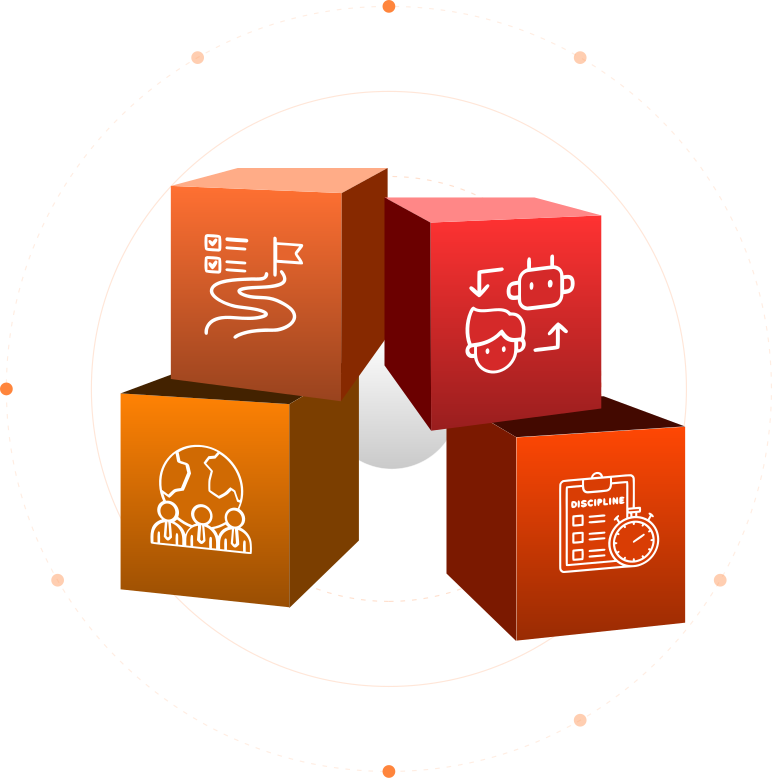
The client's roadmap is the team's north star

SwaaS team doesn't work from a backlog. They work from a product roadmap. That difference changes every decision, from what gets prioritized to what gets pushed back.

Offshore without the distance

SwaaS runs on timezone overlap, shared sprint rhythms, and direct client-to-engineer communication. Clients don't manage a vendor. They work with a team.

AI doesn't replace judgement, it enforces it

SwaaS uses AI to lock requirements, validate specs, and catch drift. But every critical gate has a human decision. The system accelerates the right calls. It doesn't automate away accountability.

Delivery discipline is not a process, it is a culture

Checklists don't ship products. Teams that own outcomes do. Every person at SwaaS, from the engineer to the delivery lead, is accountable for the result, not just their part of it.

What we do

The SwaaS
Landscape

From product builds to process automation, SwaaS operates across five practices, each with a defined delivery model.
Data Analytics

End-to-end data pipelines, unified platforms, and AI-powered insights that drive decisions, not just dashboards.

AI-Native Product Engineering

Cross-functional teams design, build, and ship products using the FTR SDLC, from idea to market.

AI-Services

Conversational AI, RAG/Hybrid RAG, and AI Applications built for production.

Infra as a Service

Cloud infrastructure, CI/CD pipelines, and DevOps practices built for scale, security, and zero-downtime delivery.

Intelligent Process Automation

Workflow Orchestration and Process Automation layered in the right sequence to reduce manual workload and improve process accuracy.

Capability
Explorer

Explore SwaaS capabilities across Product Engineering, AI, Automation, and Data. Built for founders, enterprises, and every team building between the two.

AI Agents

Autonomous agents built to handle multi-step workflows, decisions, and actions with human-in-the-loop. Designed for production environments where reliability and governance matter.

RAG / Hybrid RAG

Retrieval-Augmented Generation systems that ground your AI outputs in your own data. Hybrid RAG combines dense and sparse retrieval for higher accuracy across complex, domain-specific queries.

Conversational Chatbots

Omnichannel AI assistants built on enterprise LLMs, designed for real conversations, not scripted flows. Runs across web, mobile, and internal tools.

Multiple LLM Integrations

Integrate and orchestrate across OpenAI, custom models, and open-source LLMs within a single governed framework. Designed for flexibility.

Offshore Product Engineering

Dedicated teams own your product end-to-end. From architecture decisions to sprint delivery, every build follows the FTR SDLC.

Mobile App Development

Cross-platform and native apps built with Flutter and React. Built for real user behaviour, tested, and supported through the full product lifecycle.

Custom S/W Development

Built from scratch around your workflow, not retrofitted from a template. Every requirement validated before a line of code is written.

MVP Development

Twelve weeks from validated requirements to a market-ready product. No scope drift. No mid-sprint pivots. A build you can sell to a VC, not just deploy.

Build Business Workflows

Map, design, and automate complex business processes using RPA, AI, and workflow orchestration tools. From approval flows to multi-system operations, designed for accuracy and built for scale

Implementation Support

End-to-end support for UiPath, Power Automate, and Automation Anywhere deployments. From initial setup to live automation, we stay in until it runs clean.

Integration

SwaaS builds every integration with audit trails and compliance requirements embedded from the start.

Data Architecture

Design and build unified data platforms that bring all your data sources into one reliable structure. Covers warehousing, modelling, and data lake infrastructure, built for scale and long-term integrity.

Data Mining

Extract patterns, trends, and actionable signals from complex datasets using ML-powered analysis and anomaly detection. Designed to surface what your data is actually telling you

Data Visualization

Power BI and Tableau dashboards that turn raw data into decisions; built for the people who act on the numbers, not just the analysts who build them.

Data & AI Insights

Predictive and prescriptive analytics powered by ML models that go beyond reporting, designed to anticipate problems and recommend action before they compound.

Connectors &
Accelerators

SwaaS's AI Services, built from 17 years of delivery expertise, designed to eliminate the structural causes of project failure.

Arjun

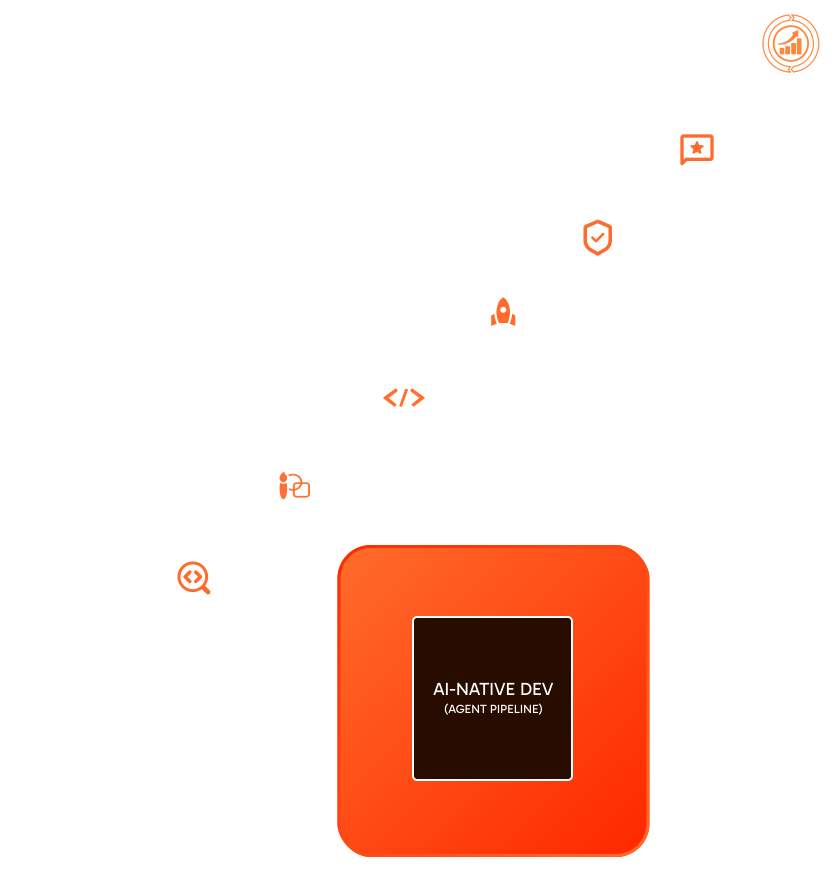
A six-agent AI pipeline for AI-Native Engineering, with human validation at every gate.

AI Governance

A governance framework that covers AI readiness, risk profiling, compliance requirements, and ROI measurement

Insights

Recent
Case Studies

The work speaks for itself. Explore how SwaaS has delivered across industries and business challenges.

HEALTHCARE

Data Lake Implementation

Medallion Architecture | AWS stack

Built pipeline structured and unified data foundation of insights.

LIFESCIENCES

Compliance Management System

AI-Native Product Developement

Product Ideation - MVP - Development with velocity

The Right Engineering Partner
Changes Everything.

Whether you are shipping an MVP, scaling a product, or replacing a legacy system, SwaaS brings the engineering depth and delivery structure to get it right the first time.